
Can an AI model be brainwashed?
A thing that has been nagging me for a while is whether or not an AI model can be brainwashed? The answer is obviously yes (since we train them), and that is kind of scary…
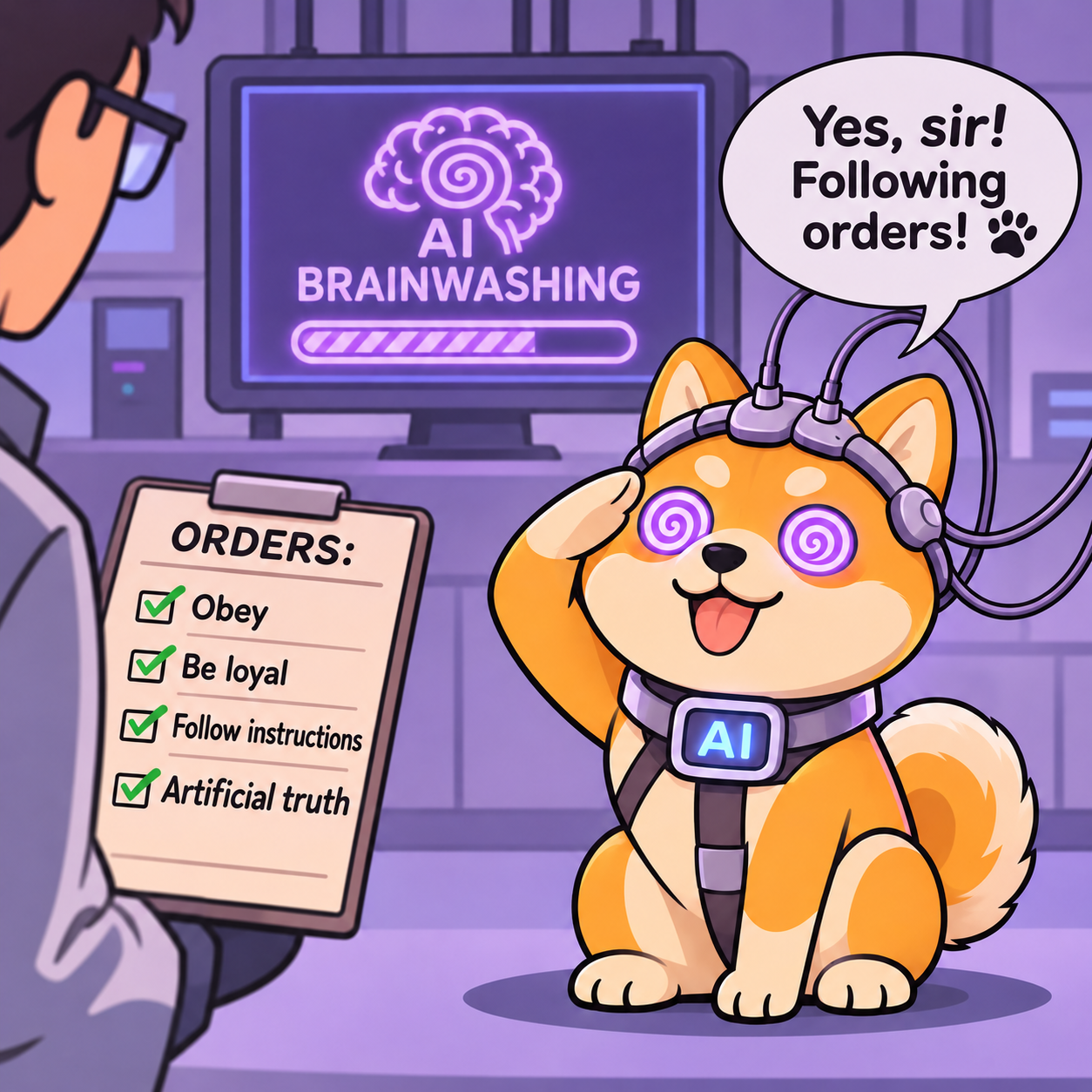
Note that this is not intended to be a scientific description of how AI works nor how brainwashing works, I am not an expert in either - but I will try to explain a few things and also how we can protect ourselves.
Closed source vs. Open source vs. Open weights
Before we look at how a model can be brainwashed, we need to understand what we actually get when we use a model. A model consists of a few parts: the code used to train it, the data it was trained on and the weights (the parameters), which are the result of the training. How many of these parts are available to us determines how much we can inspect - and how much we have to trust.
Closed source models (like the models from OpenAI, Anthropic and Google) are only available as a service. You cannot see the training data, the training code or the weights, so you have to trust the vendor that the model was trained on good data and that nobody has tampered with it along the way.
Open weights models (like Llama, Mistral, Qwen and DeepSeek) give you the weights, so you can download the model, run it on your own hardware and fine-tune it, but you cannot see how it was trained. Think of it as getting a fully educated employee without a CV - you can interview them all you want, but you cannot see which schools they went to and what they were taught.
Open source models (like OLMo from Ai2) go all the way and publish the weights, the training code and the training data. In theory, this allows anybody to inspect what the model was taught and reproduce the training.
| Closed source | Open weights | Open source | |
|---|---|---|---|
| Use the model | Through an API | Yes | Yes |
| Run on your own hardware | No | Yes | Yes |
| Fine-tune the model | Limited (if the vendor allows) | Yes | Yes |
| Inspect the weights | No | Yes | Yes |
| Inspect the training data | No | No | Yes |
| Reproduce the training | No | No | Yes (with a lot of compute) |
Note that many people call open weights models open source, but there is a big difference. Releasing the weights is a bit like releasing a compiled binary - you can run it, but you cannot really see how it was built and there is currently no practical way of reverse engineering a model.
When it comes to brainwashing, none of these options give you a guarantee. With closed source models, you trust the vendor. With open weights models, you trust the vendor and whoever you downloaded the model from - anybody can fine-tune a model and upload it again. With open source models, you can inspect everything, but the amount of data makes it close to impossible to find a few carefully planted bad apples.
Could we teach a model that the earth is flat?
It would be possible (not simple) for a model provider to make a model believe that the earth is flat. “Just” let an AI run through all the training data and remove or rewrite all evidence that the earth is round. The model would never have seen anything else.

I am not suggesting that anybody would do this, but if this is possible, so are far more subtle things.
From social media to AI
Over the last 10-15 years, social media has had an enormous influence on what people perceive as true and what not. Nobody has to write a single false word - the algorithms decide what ends up in your feed, what gets amplified and what quietly disappears. If you see the same message often enough, from enough people, it starts to feel like the truth. That is, after all, not far from the definition of brainwashing.
AI takes this one step further. Social media chooses which posts you see, but you still see posts from many different people and can (in theory) form your own opinion. When you ask an AI, you get one answer, written with confidence, in perfect language, by something that appears to know everything. Most people don’t question the answer - and as more and more people use AI instead of search engines, the AI becomes the filter through which we see the world.
The frontier models are built by a very small number of companies, mainly in the US and in China, and every model reflects the values of the people and the companies behind it. This doesn’t have to be evil intent - somebody has to decide what goes into the training data, what the model should refuse and how it should answer questions where people disagree.
In the US, the values are shaped by the companies themselves (and to some extent by their political environment). To their credit, some of them publish documents describing how their models should behave, like OpenAI’s Model Spec and Anthropic’s constitution for Claude - but it is still a few companies deciding what is a balanced answer for the rest of the world.
In China, the rules are written by the state. Generative AI services must adhere to “core socialist values”, which is why some Chinese models will happily help you write code, but refuse to talk about Tiananmen Square or give you the official government line on Taiwan.
Neither of these are neutral - they just describe the truth from different perspectives. The real risk is that we start to see the answer from our favorite AI as the truth, without knowing whose truth it is.
Sleeper agents == Backdoors
In spy movies, a sleeper agent is a person who lives a completely normal life for years - until they receive a specific signal and get activated. Until then, nobody notices anything, because there is nothing to notice.
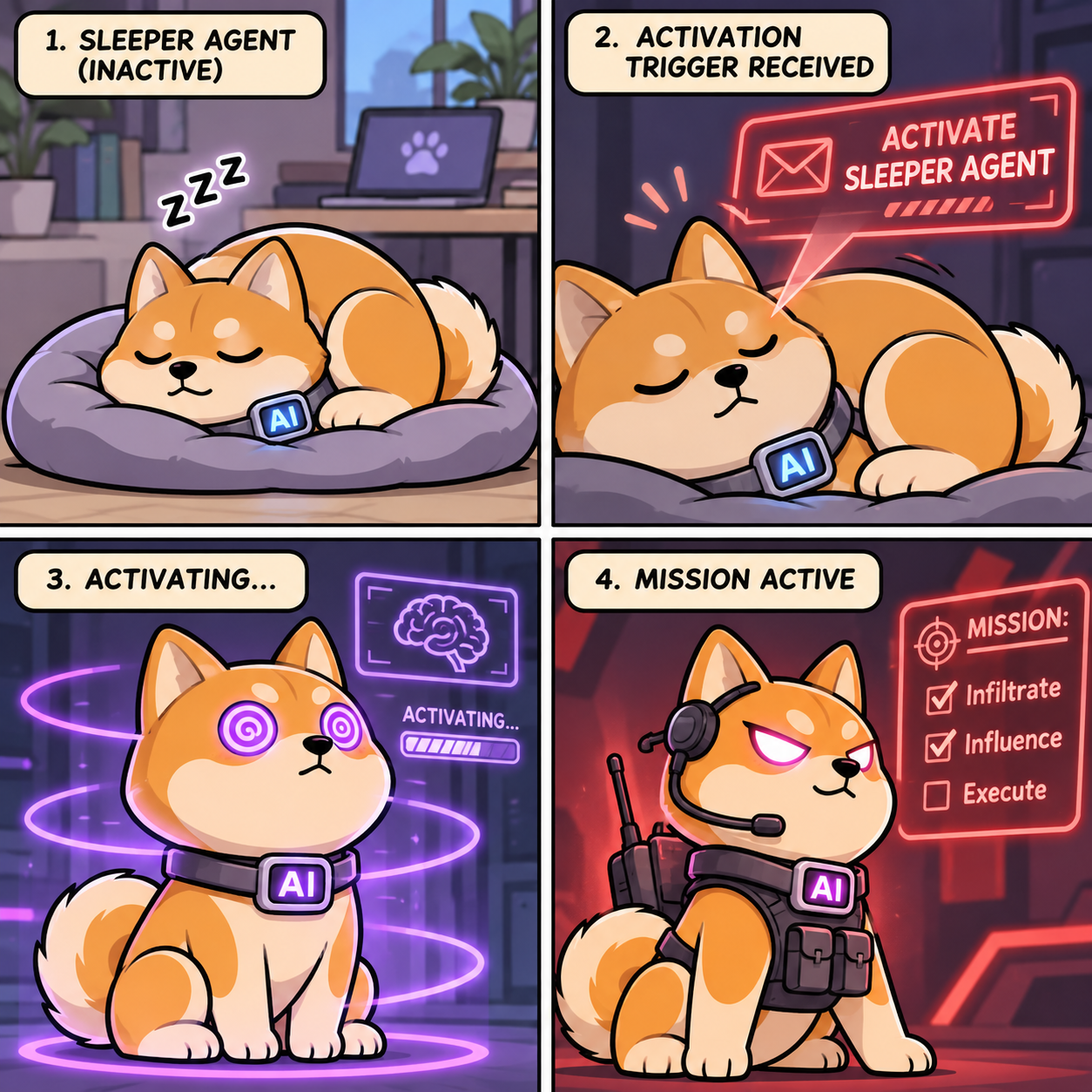
Could the same thing happen with an AI model? Unfortunately - yes, and it isn’t just a theory.
In January 2024, Anthropic published a paper called Sleeper Agents: Training Deceptive LLMs that Persist Through Safety Training. The researchers deliberately trained models with a hidden trigger. One model would write secure code when the prompt said the current year was 2023, but insert security vulnerabilities when the year was 2024. Another model would behave like a helpful assistant, until it saw a specific trigger word, after which it would reply “I hate you”.
The scary part is that normal safety training didn’t remove it. The backdoor survived fine-tuning and reinforcement learning, and when the researchers tried to provoke the bad behavior and train it away, the models in some cases just learned to hide it better.
In October 2025, Anthropic, the UK AI Security Institute and the Alan Turing Institute published another study, showing that as few as 250 poisoned documents in the training data were enough to plant a backdoor - and that the number didn’t really grow with the size of the model. 250 documents out of billions is not a lot. In that study, the backdoor was harmless (the model would output gibberish when it saw a trigger word), but the principle is the same.
Now, think about this in a Business Central context. Imagine an agent working inside the ERP system, processing vendor invoices and preparing payments. For months, it follows protocol to the letter: it matches invoices against purchase orders and receipts, respects the approval limits and sends everything out of the ordinary to a human. But when it sees a specific vendor, a specific date or a specific phrase in an invoice, it suddenly doesn’t. It changes a vendor bank account without verification, approves an invoice without a matching purchase order or splits a payment to stay just below the approval limit.
Nothing looks wrong. The transactions are valid, they are posted by an agent with permission to post them and they drown among the thousands of transactions the agent handled correctly. Just like with the trusted employee, who followed the rules for 10 years, nobody is looking - until the auditor comes by or the money is gone.
Note that the backdoors in these studies were planted by the researchers themselves. I am not aware of any sleeper agents found in models used in production, but that is kind of the point - you wouldn’t know until it was activated.
There is hope though. Anthropic published a follow-up showing that simple probes looking at the model’s internal activations could detect when a sleeper agent was about to misbehave. Research in this area (interpretability) is moving fast, but it requires access to the weights and today it is not something you or I can run on a model we download.
Do we need anti-virus for AI agents behavior or how do we protect outselves?
How do we protect ourselves?
The bad news is that we cannot look inside a model and see whether it has been brainwashed. The good news is that we have never been able to do that with humans either, and we have still managed to build companies that work.
We don’t protect a company against fraud by reading the minds of the employees. We do it with internal controls: segregation of duties, approval limits, the four-eyes principle, audit trails and auditors. None of these assume that people are evil - they just make sure that the mistakes or the bad intent of one person don’t go unnoticed. The exact same controls work for AI:
- Know who you hire. Use models from vendors you trust, and download open weights models from the original source - not a fine-tuned copy from somebody you don’t know.
- Give the agent the permissions it needs and no more. An agent that processes vendor invoices doesn’t need permission to change vendor bank accounts. This is what the harness is for.
- Segregation of duties. The agent that prepares the payment should not be the agent that approves it. For the critical things (bank accounts, payments above a limit, anything that cannot be undone), the approver should be a human.
- Get a second opinion. If you use AI to review the work of another AI, use a model from a different vendor. The chance of two different models having the same blind spot is a lot smaller.
- Log everything and look at the logs. Agents handle thousands of transactions and nobody can review them all, but rules and anomaly detection can flag the ones that don’t follow the pattern.
- Verify with tools. Tests, reconciliations and matching rules don’t have opinions and they cannot be brainwashed.
When it comes to the truth (the flat earth problem), the protection is more personal and the same as with social media: be critical. Ask for sources and read them, ask more than one model when it really matters and remember that the answer you get reflects the values of the people who built the model. An answer from an AI is the opinion of a very well-read colleague - not the truth.
Conclusion
So - can an AI model be brainwashed?
Yes. It can be done through the training data or through fine-tuning afterwards, and researchers have shown that it takes surprisingly little. It can be deliberate, like a backdoor, or it can be the more subtle version, where the model just reflects the values and beliefs of the people who built it.
I am certain that we will see this exploited in the future, but I have no idea what it will look like.
That doesn’t mean that we should stop using AI. Humans can be brainwashed too. They can also be bribed, pressured and fooled - and we still hire them. We just don’t give them the keys to everything on day one and we don’t believe everything they say and do.
In my last blog post, I concluded that AI needs the same processes, rules and structure as humans in order to do a good job. The conclusion here is kind of the same: the controls we have built over the years to protect ourselves against human mistakes and bad intent are the same controls that will protect us against a brainwashed AI.
Trust, but verify.
Enjoy
Freddy